Science
-
Science
NASA’s Nancy Grace Roman Space Telescope Surpassing Expectations Even Before Launch, Reveals Research
Roman Telescope has been designed to study the vibrational patterns of millions of stars. Roman Telescope may reveal the largest-ever…
-
Science
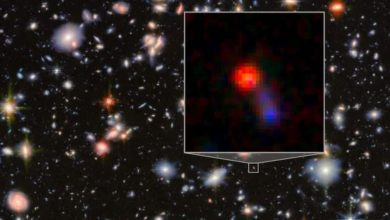
James Webb Telescope May Have Discovered Universe’s Earliest Supermassive Black Hole
The find demonstrates JWST’s ability to expand the horizons of our knowledge of the universe. Galaxy GHZ2 may host the universe’s…
-
Science
Comet C/2025 K1 (ATLAS) Breaks Into Three Pieces Following Close Approach to the Sun
This encounter presented telescopic views of comet C/2025 K1 (ATLAS) and its fragments Fractured comet C/2025 K1 (ATLAS) captured streaking…
-
Science
Boiling Oceans May Hide Beneath Icy Moons, New Study Suggests
New research reveals icy moons may host boiling subsurface oceans where life could still survive. Icy moons may hide boiling…
-
Science
Dark Matter May Have Been Seen for the First Time in NASA Gamma-Ray Data
NASA’s Fermi telescope has detected a 20-GeV gamma-ray halo around the Milky Way’s center that may match dark-matter annihilation. Fermi…
-
Science
James Webb Space Telescope May Have Spotted the Universe’s First Stars, Astronomers Say
JWST may have captured signs of the first Population III stars in galaxy LAP1-B, thanks to its infrared sensitivity and…
-
Science
Interstellar Comet 3I/ATLAS Photographed Beside Distant Galaxy in Rare Cosmic Shot
A new image of 3I/ATLAS shows its multi-tailed structure beside a distant galaxy, revealing rare interstellar details. Interstellar comet 3I/ATLAS…
-
Science
Battery Breakthrough Could Make Solar Panels Cheaper and More Powerful
A new salt-forming method gives perovskite solar cells a record 27.2% efficiency and improved long-term stability. A new ion-balancing method…
-
Science
China’s Tianwen-1 Captures Rare Interstellar Comet From Orbit Around Mars
China’s Tianwen-1 captures interstellar comet 3I/ATLAS, showcasing Mars-based deep-space imaging success. The interstellar comet 3I/ATLAS, imaged from Mars orbit by…
-
Science
Scientists Just Solved the Mystery of the Moon’s Lopsided Dust Halo
Research shows the Moon’s dust halo is thicker on the sunlit side because warm soil launches more dust during daytime…